


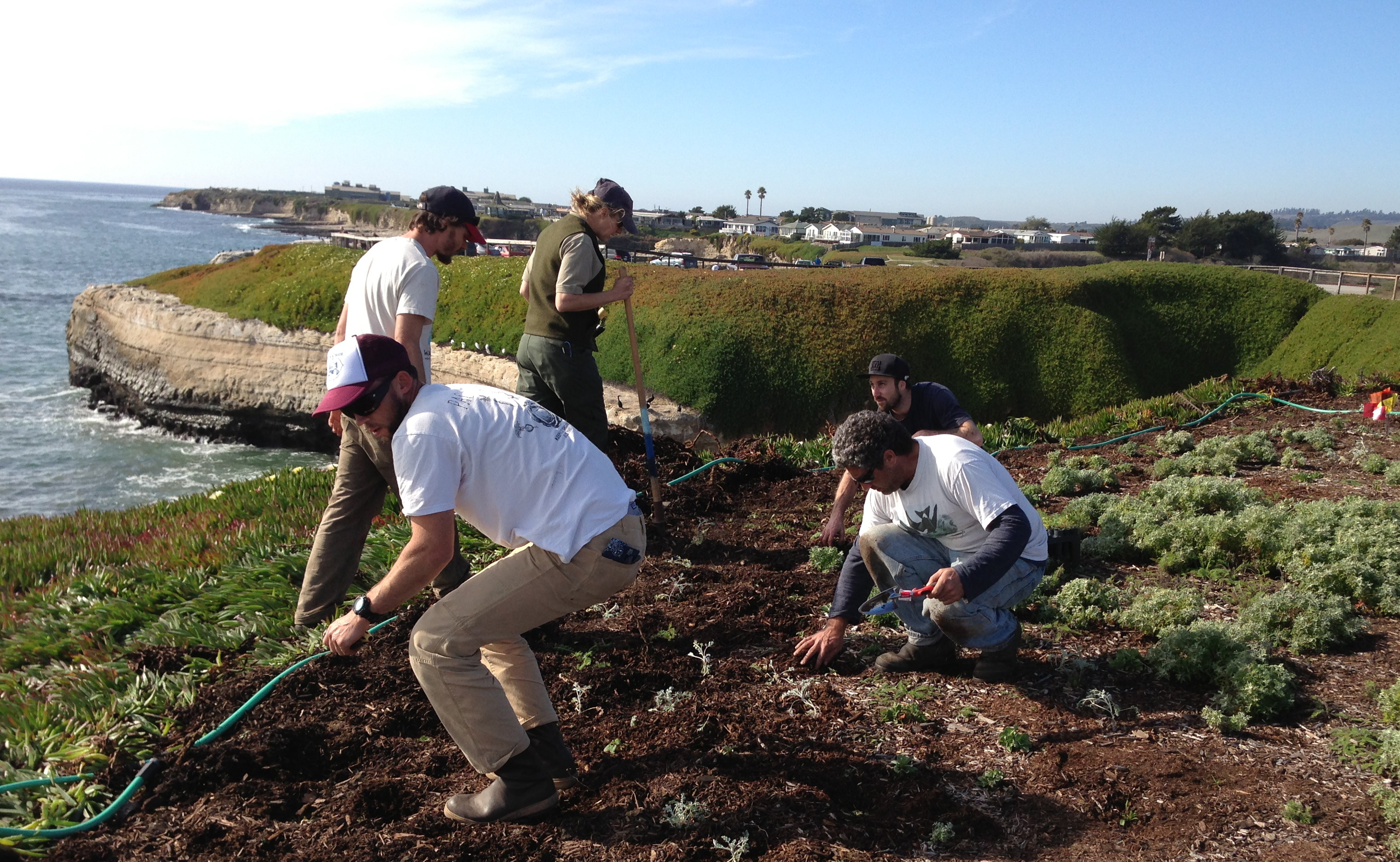
Ecologist Josh Adams (kneeling in white shirt) plants native plants in an area cleared of ice plant near the entrance to Natural Bridges State Park. Photo: Melissae Fellet
By Melissae Fellet | KUSP News
With its ocean views, walking path, and ice plant-covered cliffs, many in Santa Cruz consider West Cliff Drive to be a jewel of the community. Now a couple of scientists want the community to help them restore native habitat to the coastal bluffs.
They’ve started the non-profit to help organize the restoration. Last winter, volunteers with the group ripped out ice plant in a small bed near the entrance to Natural Bridges State Park.
“Having the community participate in it is really important,” says Bill Henry, an ecologist at Moss Landing Marine Laboratory, who helped start the non-profit. “Oftentimes projects happen where people come into a community and do some point change and then leave. And a lot of times that model doesn’t really work. A lot of projects take some follow up.”
Locals Pitch In to Restore Local Habitat
On February 1, Henry was back with volunteers, working to widen the original bed and adding more native coastal bluff plants.
“This way we’re trying to get community members to help out and have a vested interest in their backyard,” Henry says. “That automatically sets the stage for care taking of our environment and of our backyard. And this is a perfect place because so many people from our community use the West Cliff corridor.”
, a small non-profit conservation organization, is one of the partners in this local habitat restoration effort. Ryan Carle, a project ecologist with the group, said that people were stopping all the time to ask about what they were planting. Some of those people wanted to know why they were removing ice plant, he says.
“A lot of people don’t realize that the ice plant is a non-native invasive species and don’t know about our local native species,” Carle says. So he stopped to talk to them about the difference between ice plant and a native habitat. “When they learn about our local native species, how beautiful they are and what they’re bringing to the ecosystem, then they’re excited.”
The yellow or pink flowers on plants like yarrow, gumweed and sea pink attract wintering monarch butterflies and other insects. They also shelter lizards and salamanders. Birds may nest in the grown shrubs.
The community helped bring these native plants from seed to seedling as well. California State Parks provided seeds from plants native to coastal bluffs and scrub. Ecologists at the University of California in Santa Cruz grew the seedlings in their greenhouses. The City of Santa Cruz helped the scientists figure out how to truck tons of removed ice plant to the dump. And on this work day, volunteers from the Patagonia store in Santa Cruz are helping to plant more seedlings.
, an ecologist with the United State Geological Survey who worked with Henry to start the restoration project, says that school groups, of all ages and class levels, can get involved too.
Restoration Project Provides Outdoor Education
In late January, students from the Gateway School helped to restore a site at Pelton and West Cliff across the street from the surfer statue. Adams says the project is a chance for students to learn about math, ecology and native species.
The junior high math class mapped out the site and calculated the area so that the workers could determine the density of the planting, he says. The fifth grade class was in charge of growing the seeds.
“They came in with their plants that had been growing since the fall and in one fell swoop they planted that little section out,” Adams says. “What could be funner than coming out, sticking your hands in the dirt and seeing a plant that you’ve shepherded along for nine months put into the ground and then to drive by that and see it in the future? It’s great.”
Community participation is important to their habitat restoration efforts, Henry says. “We all enjoy this, and most times we’re not active participants,” he says. “So you get out here, and you get people working and then they’re a part of the environment. And we are. We can’t take ourselves out of nature or ecology. We’re a part of it one way or another.”
And working as a community, we can return a human-influenced environment back to its native state.


